 SunCalc.app
Guide 02 · Shadow length
How long will the shadow be?
A low sun casts a long shadow. With an object’s height and the sun’s altitude, you can put a number on it.
The level-ground calculation
For an upright object on level ground:
shadow length = object height ÷ tan(sun altitude)
Use the same unit for the object and the result. For example, a 2 m post with the sun 45° above the horizon casts a 2 m shadow. At 30°, it casts about 3.5 m; at 10°, about 11.3 m. The relevant angle is altitude above the horizon, not the compass bearing.
Try it in SunCalc
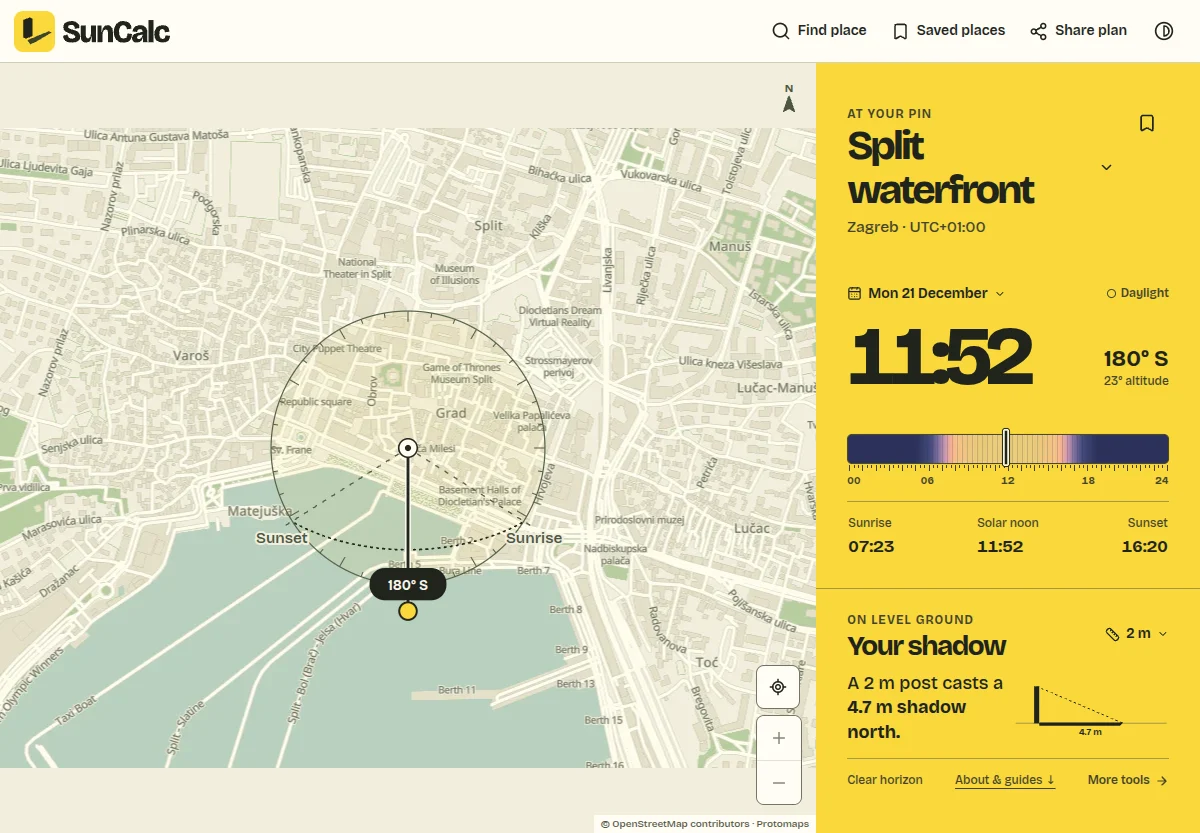
- Choose the location and date, then move to the time you want to check.
- Select the height beside Your shadow and enter the upright object’s height in metres.
- Read the estimated length and direction. Open More tools → Shadow & light details, then choose Show shadow on map to see the ground-level projection.
The shadow points opposite the sun: add 180° to the sun’s bearing and wrap around at 360°. A sun due south casts a shadow north. At night, the app shows “No direct shadow” because this calculation concerns direct sunlight.
A worked seasonal comparison
At the Split waterfront on 21 June 2026, solar noon is about 12:56 local time and the sun’s altitude is about 69.9°. A 2 m post casts a shadow of about 0.7 m. On 21 December, solar noon is about 11:52, the altitude is about 23.1°, and the shadow is about 4.7 m.
Comparing solar noon keeps the example tied to each day’s highest sun. Comparing an identical clock hour is a different question, especially when daylight saving changes.
Limits of the estimate
This is useful for understanding a pole, an upright person, or a simple vertical edge on flat ground. Sloping ground changes where the shadow meets the surface. A roof, tree canopy or irregular building needs more geometry than a single height.
SunCalc does not detect nearby obstacles or calculate a garden’s shaded area. It also does not account for cloud cover or scattered light. As the sun approaches the horizon, the ideal length grows rapidly and becomes less useful as a practical prediction.
For a real site, compare the estimate with an observed shadow and note any slope or obstruction. Learn why the seasons change the result.
Updated · Matija Radeljak